Thursday, April 8, 2010

The Media's Portrayal of Preppy

The media, specifically the entertainment industry, portrays preppy women and men in unique and over-exaggerated ways. Identifying stereotypes assigned to preppy people is not incredibly important in surpassing negative typecasting or marginalization in the media, but I still find it interesting to examine how preppy people are portrayed. I've identified two types of preppy, country club-esque preppiness characterized by argyle, pastel colors, and alligator embossed sweaters and new wealth preppy characterized by fake tans, gold chains, and huge sunglasses. The first form of preppy often comes attached to wealth and intense neurosis or intense laziness. Sometimes they play the super controlling and anal-retentive best friend or mother and sometimes they play the lazy frat boy who doesn't need to do anything as they'll inherit their parents wealth and/or big bucks empire. Below are a few pictures of characters who fulfill this type of preppy.
Above is Taylor Townsend from the popular teen show The O.C. and Andy Bernard from the Office. Taylor represents the neurotic preppy who has a rough family life and tries to take control of life through controlling others. She's actually a bit of a tragic character because her preppy guise is all part of her trying to fit in, and in some ways she superimposes the preppy stereotypes upon herself in order to fulfill some standard she fells she needs to reach. In some ways preppiness in the media is used to represent misguided or misunderstood characters. Andy Bernard above spends all his time talking about his ivy league education at Cornell and flaunting his bow tie collection, but he has absolutely no game and is constantly failing at picking up a girl in the office who already really likes him. He's a hilarious character and is completely lovable as he's very genuine in his pursuit of her and his pursuit of the other's acceptance, but he seems to use preppiness to pretend to be something he's not. Only the makers of the documentary in the show are able to capture his true side.

Below is a video for Smirnoff alcohol that blatantly pokes fun at the phoniness that is preppiness. Preppy people in the media are often portrayed as fake. While some of them are used to represent troubled characters like Taylor and Andy, some are used to represent the necessary big jerk. Sure, people who attend prep schools and wear lilly pulitzer and vineyard vines can be perfectly nice, but often they're used as the prop for making jokes about wealth and privilege. This video is really funny, and it also represents an amazing advertising feat. I appreciated all the preppy terminology they use, including "wasp," "Martha's vineyard," "Greenwich," "New England," "yacht," "ivy league educations," topsiders." Many of these words don't naturally involve preppiness, but have become associated with wealthy, preppy, people over the course of what I imagine has been many years. This video epitomizes for me the way the world views people who attend prep school. Of course, this is a huge over-generalization, and I've spent countless hours convincing friends from home that the people at my school aren't all like this.


What is appealing about having character's like this in television shows? Besides for often being humorous, it seems this lifestyle is not exactly envied by many people but reminds us all of what we're working for in our lives. These people are prospering. They have money, they have girls, and they have tangible success. A lot of us aren't looking for polo shirt filled futures complete with yachts and crochet. We might look to find other means of success, but at some point it would be nice for all of us to have tangible success like them. We might want homes or cars or children or businesses of our own.

The West Coast preppy portrayed in the media often represents success in beauty and looks. West Coast preps are portrayed as stunning yet overly made up and tanned, something that while we might not strive for, represents an ideal that many of us look towards. Looks matter a lot in our culture, probably a lot more than they should, and we all have goals for perfect bodies or nicer skin. Some of us just want to be comfortable in our own skin, like these confident people on television are. The below video shows Smirnoff's representation of West Coast preppy. The guys are wearing tight v-neck shirts, the girls close to nothing. The hit words they use to represent the wealthy preppy population of the west coast are "botox," "new wealth," "higlights," "platinum blonde," "implants," "gated community," "designer sunglasses," and "life coach." These words are not inherently preppy but they're used often when describing apparent west coast preppiness.


It's easy to identify the stereotypes of preppy people, from both the east coast and the west coast, but its difficult to identify why these characters appear so often in television and movies. There are many representations of wealth and beauty that can be used in television. It's really not necessary to have wealthy people wearing preppy clothes anymore for people to understand that they're of the upper class. I wonder if it has something to do with the accessibility of stereotypes pertaining to preppiness. We've all been exposed to the media's representation of preppy time and time again and have learned the little undercurrents that run from preppy character to preppy character. Maybe the media uses preppy characters because we're predispositioned to believe they'll be beautiful but troubled, wealthy but snotty. In some ways preppy characters could be short cuts, used to represent the exact things the director or writer believes the public believes of preppy people or they could be used to surprise us. When we see a preppy person who is nice in television it's often surprising. When we see a preppy person who works really hard it's often surprising. The preppy character can be used in many different ways, but they all seem to represent some form of financial and aesthetic success.

Tuesday, April 6, 2010

Good, Bad, Nice, Mean, Frenemy, BFF...

The one thing our society seems to demand most from the media is controversy. We look to involve ourselves in debates, tiffs, and sometimes even full on fights. The media dichotomizes every story, something we've talked regularly about in class. Americans are either with the country or against it. They're pro America or against it. There's no in between. Lately I've seen that a hybrid zone of sorts is nonexistent in the gossip magazine section of the media. Women figures especially seem to be broken up into different categories. They're nice or they're bad. They're pop stars or they're rebels who sing rock. They're blonde bombshells or dark beauties. Each celebrity is put into one or another category, and rarely are they described as more than one. The categories they're broken into are not always negative. Blonde versus brunette isn't necessarily a deeply controversial split, but it's demonstrative of the way celebrities are often portrayed by the media. Celebrity brand names are so often based on the categories of beauty and talent that the media places them in.

I was looking at People.com today and found a perfect example of this dichotomization. In this case the media has drawn attention to their constant draw towards dichotomization. There was a photo album titled "Good Girls with Tattoos." People magazine started by placing these women into the category of "good," and then proceeded to point out the one thing they had in common that was particularly surprising and "bad". They act as if this mix of good and bad is a huge surprise, something completely unique to these 10 celebrities. There are only a few good girls out there that have tattoos. Also, it surprised me to see People so failingly grasp for some semblance of an interesting album. Tattoos mean completely different things for each tattooed person. One of the women, Alyssa Milano, has a tattoo of a cross on her shoulder. Does that really compare to the "Nine" Eva Longoria has tattooed to her neck or Julia Robert's children's names. All of these tattoos are relatively mild and if People.com is so eager to show that these good girls are having a bad streak, they aren't doing a very good job. What's so disappointing about this article is how eager I was to look at it. For starters, I find tattoos really interesting. It's interesting to know the reasons behind people's tattoos or try to deduce their meaning on my own. Anyways, these types of faux stories catch one's eye. The whole good girl violating that reputation draws our attention. We're so programmed to think of these celebrities in this way and we forget to even realize that these "good" girls are not just good. They aren't just bad. They're a mix, yet we're eager to put them into one category, and excited when they violate their reputations.

Another dichotomization that's interesting to see in the media is that between friends and enemies. When a couple breaks up the first thing People does is dissect the causes behind the split. Are they angry at one another? Was it mutual? What went wrong? Friends who fight are immediately labeled "frenemies," and friends that escape public critique of their relations are best friends forever or "bffs." People.com has a photo album dedicated to the famous friend pairs out there. The whole thing seems silly, so why do we buy into it so readily? Why do we sometimes demand the categorization of the women and men we look up to?

Each age group and socioeconomic group and gender probably has its own reasons for being attracted to the classification of celebrities in the news. Speaking from the perspective of a white eighteen year old female who goes to Andover, lives in the Paul Revere dorm, and takes Ms. T's media studies class, it seems I'm attracted to it because I feel my life would be simpler if I could easily be placed in a category. Life might be dull in this case, but it seems it would be easier to deal with. Making the choice of what college to go to has emphasized this feeling. If I was a preppy person I might choose one school. If I was just into environmental studies I might choose another school. All these schools have reputations that put them into one category or another and peg them against other schools. Pomona clashes with Harvard. One's "artsy" one's I don't even know how to describe Yale's reputation. If I fit the "artsy" category and knew it, maybe making college and other decisions in my life would be easier. Maybe not. Maybe only I find classification of other people's lives therapeutic in a way. It's gross to find relaxation in watching other people be stereotyped and in some ways marginalized and following their marginalization. These celebrities are barely themselves any more. They don't matter, only their images and publicity matters, yet I find it hard to keep my eyes from glimpsing at these stories and photo albums.

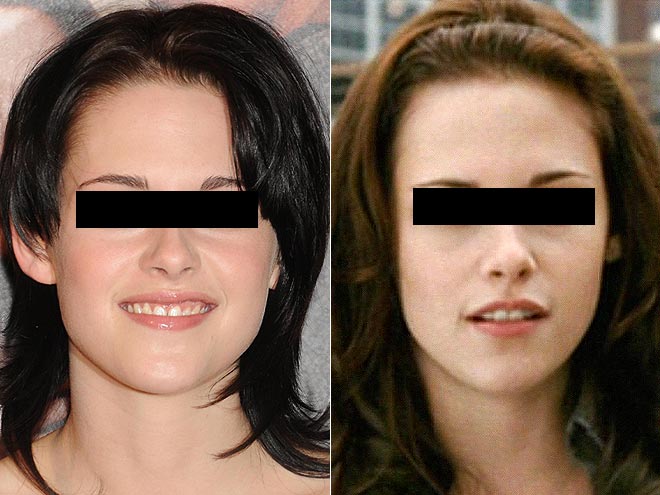
Which brunette beauty has matching brown eyes? | Kristen Stewart

Above is a quiz on People.com that asks readers to distinguish between the actress Kristen Stewart and her character Bella Swan. It really interests me that People has all but convinced its readers that there's actually a difference between the two. Sure, Bella Swan is a fictional character created by the writer of Twilight, but the Bella Swan in Twilight is still Kristen Stewart. Kristen Stewart, while maybe not the most adept actress out there, still made Bella Swan a part of herself. There's no difference between the actress and the character in the movie. Sure the actress and the character in the book are different, but that's because they're completely different human beings. They weren't related until Kristen Stewart signed on to put her own spin on the character of Bella, and bring her to life. People.com "forgets" to mention that Bella Swan is not real. They ask "Which brunette beauty has matching brown eyes." They both do silly. They're completely the same person. While our society likes dichotomizing different people and things, Kristen Stewart is a different person entirely from Bella Swan, they also want to link people together. Everyone's excited when two completely different celebrities start dating or they star in a movie together. We want to know that people who are completely different, or who the media pins as completely different, can come together and function. Bella Swan and Kristen Stewart are sooooooo similar! It's so funny and so great that the actress is so much like the character. Nevermind the fact that one's real and one's fake.

Do we hope that we'll meet people completely different from us and create some epic story? How does our desire to watch disparate individuals interact and meet one another get portrayed in television? Movies? How often does our desire to watch two opposite souls become one influence the truth we are given by the media? The gossip magazine industry is notoriously of dubious integrity, but to what extent is what we know about celebrities truth, speculation or just straight up lies? Of course there are a million more layers to celebrities than we as their followers and the American public never view, but are the layers we see accurate at all? I guess this leads me to ask, are celebrities figments of our imaginations. Are they beautiful bodies with photoshopped souls pasted onto them? Can we learn more about them from watching a celebrity act in a movie or television show than we can by seeing pictures of them as themselves in gossip magazines. To what extent are we contributing to the corruption and degradation of our news system and will the news every be free from public influence and will we ever be free from the news' influence. Will we ever be able to truly develop our own observations and opinions of a certain actor or singer before seeing them pasted across a magazine cover while checking out at Whole Foods. Even places that boast being havens for people wishing to get back to nature, display magazines such as People. Will we ever break free from the gossip magazine section of the news and will the gossip magazine section of the news ever break free from us. For them breaking free of public desire and demands means destruction, giving their livelihood up to journalists who don't want to write rumors but want to write truths. Will it ever happen?