Saturday, March 6, 2010

The Oscars, Female Celebrities, and New Media Meet

On People.com, the website of People magazine, there is an entire section on the Red Carpet. Displayed from early in the year are pictures of the SAG awards and other award shows, but the Academy Awards have the biggest section, most of it focused less on the awards themselves and more on the appearances of the people nominated for the awards or even those just attending the show. I was surprised to see that instead of being focused on the nominees and the movies, it focused on hair and fashion. Of course, I should have expected that from People magazine, and I suppose that the "Red Carpet" heading emphasized documentation of the time of photographs and dress-displaying that goes on before the awards. I was especially surprised that they focused little on people actually nominated for awards.
There was a trivia of "Guess the Oscar Dress!" and "Oscars' Baby Bumps," all displaying images of celebrities dressed up for the show, many of whom have never won nor have a chance of winning (haven't been nominated) this year. What interested me most was their "Predict the Oscar gown,"challenge. It struck me, scrolling through the pictures of celebrities and dress possibilities for them, how much goes into branding a celebrity, especially how much stalking goes into the branding of a celebrity! Each of the women featured, Penelope Cruz and even Miley Cyrus who has no place presenting at the Oscars as she's an actress on a teeny bopper Nickelodeon show, had a brand associated to them. The gowns chosen as possibilities for them were chosen based on studies of their gowns over the past few years, the jewelry they've worn, the colors they've choosen. These celebrities have been pinned as the cute Southern Girl, the hot Latina, the "mature" children's show actress. It's all there on the site, details of their pasts, and their future! Their brands have taken them to a point where the creators of People are creating a future of sorts for them, based on all the branding they've been subjected too over the course of their fame. What's even funnier is that most celebrities have publicists and stylists that shape their brand for them. They have agents who choose movies. Their brands, based on the littlest things such as how much money they earn per movie, are all manipulated. They're all pretty much fake!

I suppose it's like advertising for Nike if you're a shoe vender. If your business is based on celebrity gossip, you better be advertising the celebrities, even those that aren't the most consequential at the time (those who aren't nominated or aren't even actresses). Even if Nike has a brand new type of shoe, many vendors advertise all of their old shoes too.

How has new media changed the branding of the female celebrity, the way she is approached by the media during times when her career as an actress/singer and a fashionista is being scrutinized and the scrutinization is being funneled into a brand name and image? This year is the 82nd Academy Awards. How has each year, each new technology, each change in the way technologies are used, changed the way celebrities are viewed around this time? Branding of a celebrity has many levels and many influences. A female celebrity's family life, her style choices, her acting career, all go into her overall brand, and during this time, the Oscars, each aspect of her life is examined. Brands are added to each year, they're enforced by years of emphasis on certain aspects of a celebrity. New media seems to allow all these aspects to be compiled, and studied together over the course of many years, the ones that seem most defining or are made most defining by a tabloid or a certain event, emphasized further. A celebrity's brand is years thick, reinforced with new pictures and commentary every year. People.com also has a "Cursed! From Oscar to Split," section showing couples who were present at the Oscars together, but now are broken up. Another section is the "Which Couple Should Make Their Red Carpet Debut Oscar Night?" poll. Couples are starting to be branded together. Eva Longoria Parker and her NBA playing husband carry a significant brand, based a lot on the fact that she's about 5'2" and he's at least 6'2." Images of them together at shows such as the Oscars go into their brand, and every year their size difference is emphasized, showing that they are a branded couple who defy height discrepancies trying to keep them apart! In fact, their different heights, according to the media, represent the way they balance one another out, making them the perfect couple. The Oscars is the time of ultimate branding, so how has the branding changed?
In the 30s Joan Crawford and Bette Davis were famous, the forties, Lucille Ball, Katharine Hepburn, Veronica Lake, Vivien Leigh, and Ava Gardner. Grace Kelly, Marilyn Monroe, Kim Novak, Brigitte Bardot, and Elizabeth Taylor all held the attention of audiences and the media in the fifties. So many celebrities have been in the spotlight for the past ninety years! How has the media changed in the way they brand them? How did the Oscars and award shows contribute to celebrity branding during the 20s and 30s and 40s. The 50s and 60s? Were celebrities less branded back then, when brand names were less emphasized than they are now? By the sixties, at least, celebrities were definitely starting to carry brand names that have lasted through the millennium and continue to hold strong.


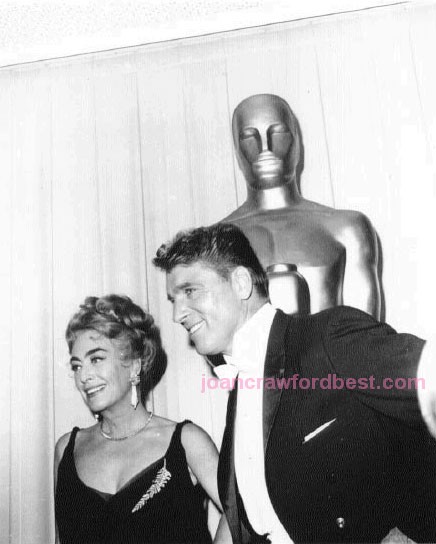
April 9, 1962. At the Oscars, with Burt Lancaster.
Above is Joan Crawford at the 1962 Oscars, after her time in the spotlight, but warranting attention all the same. She looks regal, classic, and many of the sites I looked at boast her time-defying beauty.

Olivia de Havilland with her Academy Award

Olivia de Havilland won best actress in 1946 (above). Vivien Leigh (below) won best actress for Gone with the Wind in 1939.

Vivien Leigh with her Academy Award

The photos are in black and white, they show women wearing different styles, but they are all in the spotlight. They were all subjected to the media's spin on their apparel and the awards they won. While looking for these photos I found little commentary on the actresses from the time of their fame. This probably has a lot to do with the technology the media had access to at the time. The articles I did find placed more emphasis on the awards and the movies the actresses were in, their actual careers, rather than the fashions they were sporting. Also, the coverage of their lives, their families and boyfriends, was much less emphasized.

Has the new media single handedly transformed celebrity branding into a spectacle where everything is known and public about celebrities? Of course new media has subtracted from privacy and augmented gossip, but to what extent? How has it changed the gossip being discussed? Has a shift in values in American society created a fascination with knowing everything about our favorite movie stars, with the new media just serving as vehicle for playing out these values?

Marilyn Monroe's rumored 1960s affair with JFK was scrutinized by the public and the media. She was criticized for a "sexy" birthday song she sang to him around the time of their apparent affair. While Marilyn Monroe was considered seductive and the ultimate womanly woman, Audrey Hepburn was praised for her beauty too, both of them living at the same time and occupying the same media sphere. They have completely different brands. Hepburn is considered lady-like, giving (she was greatly involved in UNICEF efforts), traditional, while Monroe is considered daring, defying the time she lived in by emphasizing her sexuality and body.


Looking for pictures of these women at the Oscars, I stumbled upon a website (sodahead.com?) that seemed like a dubious information provider, but had started a debate as to who was more naturally beautiful Audrey Hepburn or Marilyn Monroe. This type of media attention must have followed the two girls around throughout their careers. When I googled Marilyn Monroe and Audrey Hepburn I came to about three sites on the front of Google who had polls going of Audrey versus Marilyn beauty wise. Only one of the sites even mentioned their acting skills or careers. Does this emphasis on image we see today, what kinds of men an actress chooses to date, what her dress looks like and her boyfriend's clothes, always been placed on actresses above their careers? For People.com and other tabloids the Oscars are less about the movies and more about the images of people interacting in a space where movies brought them together. Have female celebrity brands, those of actresses specifically, always been based more on images of them at work or at events surrounding their work than the actual work they're doing? Has new media just allowed this pattern to be emphasized more in accessible forums? Is this emphasis on image rather than content balanced out by other branches of the new media, such as those providing access to the actual content exclusively, Itunes, OnDemand, without commentary on the actors or actresses in it.

How do the Academy Awards resist the urge to give awards to actresses or actors that are particularly famous at the time. This would allow for more movies to be made with that star, and more money to be generated in the industry. Would Americans protest as a united front against giving bad actresses or actors with nice faces and pretty spouses awards? It's said that most of the Academy Awards given are influenced by producers with deep pockets, but why haven't producers started sponsoring, by securing them awards, the careers of actresses and actors who are just a pretty face so as to deepen their brand and their brand's ability to make money. I know little about what makes a good actor or actress, so for all I know we've already gotten to the point where the majority of awards given aren't to the best of the best. Have we gotten to a point where nominations and praise for an actresses or actors work doesn't really matter in influencing their fame? Some actresses and actors brand names are based a bit on them having noticeably little skill but very good looks and an interesting personal life. New media is definitely changing the way celebrities at the Oscars are viewed and how the Oscars influence the way they're viewed the rest of the year, but how exactly?

Friday, March 5, 2010

The Fate of Alice and Wonderland

Tomorrow I'm going to see Alice in Wonderland, actually I'm being dragged to see Alice and Wonderland. Convinced that it will be a perfect study break, my friends have decided to take a mandatory field trip to see the movie. I've asked why they want to see it every day for the past week, but I've received no definitive answers. I suppose I'm trying to protect my childhood memories of glossy pages with bright colors, all of the images of weird creatures changing as Alice goes on her journey. I feel part of my aversion to the film is a desire to remain true to something my parents taught me as a child. They always encouraged me to read a book before seeing the movie version, and if I loved the book, they encouraged me often not to see the movie. My father is an avid reader, and I have yet to read a book (besides for the various chick lit my mom hands down to me), that he hasn't already read and knows a great deal about. As far as movies go, he likes watching a select few, has a few personal favorites to which he remains completely loyal, and has never found the movie version of a book satisfying. There are few movies out there that I have read the book for, and vice versa. I read Harry Potter and saw the movie, I read Inkheart and saw the movie, but I tried to avoid seeing Love in the Time of Cholera, the Grapes of Wrath, and other books whose movies I fear will take away from the way I view the characters and understand the book. I relented in eighth grade and saw To Kill a Mockingbird, only after reading the book of course, and I found the movie to be quite good.
As far as Alice and Wonderland goes I fear the images of the movie will change how I feel about the book. There are images in the book, but it still allows for some creations of one's own. The movie is a movie, the images are all put out there, each part of the story line accompanied by a redheaded crimped bowl-cut sporting Johnny Depp and bleached haired Anne Hathaway. The movie's trailer makes me wonder what audience the film is targeting. Traditionally Alice and Wonderland is a children's book, targeting younger audiences, yet the film is pg, typically not meant for young children. In all honesty the trailer looks a tad frightening to be for children. I expected the movie to be rated pg-13 after I saw the trailer, but it ended up being PG.


Johnny Depp is a skilled actor, but his skills in this case have be used towards creating the mad hatter character who has ended up sounding and looking far creepier than I expected. I suppose using actors such as Johnny Depp allows the producers to develop the characters more, each actor giving the character a new spin. While animation has been around for a while, this type of film seems to constitute new media or at least medium media. It's certainly not old and traditional, and I wonder how the Alice and Wonderland story has been changed by animation and modern technology. Lewis Carroll (Charles Dodgson) wrote Alice in Wonderland, which was originally titled Alice's Adventures in Wonderland in 1865, far before television or animation. Rumor has it that Alice in Wonderland is about a spectacular drug trip Carroll went on, and "down the rabbit hole" is often used to represent hallucinogenic drug trips. Has new media changed the book from one for adults to one for children or vice versa? In 1951 Disney produced the animated version of the film, complete with a flaxen haired Alice who looks much younger than the one in the new version, and seems to be targeted at a younger audience. Caroll received a lot of criticism for his book, as it was believed to have too many references to sexuality, drugs, and in some cases schools censured it for fear it was not just for adults but against the church. I never remember any references in the book to these things as a child, although my parents didn't let me watch much television so I probably wasn't as exposed to grown-up topics as other children might have been. According to Wikipedia, Carroll wrote the book for Alice Lidell, a girl of seven, whom he met on a boat. She asked him to tell her a story, and he produced Alice in Wonderland. This seems to hint that Alice in Wonderland was meant to be a children's story, and that new media is transforming it into a children's story that requires parental guidance. As I was looking on google for the trailer, I saw a few posts of reviews of the movie. Many of them suggested that children under 11 or 12 shouldn't see the movie as it was frightening and difficult to watch at times. That doesn't sound like the Clice in Wonderland of Carroll's nor Disney's originial movie version. The characters have become modernized in a way in the new movie. As a side note, most of the reviews praised the movie, and a few have said they thought it was a perfect modern version of the book! Pheww!


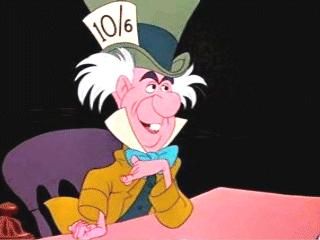
The mad hatter of 1951 looks far more tame than Johnny Depp's character. Coupled with his chirpy voice, Depp's character seems truly mad, potentially too crazy for a kid. Is this a pattern of new media taking old media (in this case books) and centering it for either the same audience, expecting that the kids of this day will enjoy the suspense and tricks in Burton's film or a pattern of centering it around a different age group? What would Jenkins' say about a parent's responsibility to talk to their child about movies like these. How does he suggest these conversations take place? Are they necessary? Does our society prepare kids to enjoy, understand, and accept movies such as these, at a younger age? Children are constantly being exposed to adult content on the television, on the radio, everywhere really. Still, there are movies made, such as Cars and Finding Nemo, for the age group Alice and Wonderland seemed to be targetting in Carroll's time and in the 1950s. Was the trippy Alice and Wonderland story inevitably meant to shift from a younger audience to an older one or has the new media, complete with modern animation, costuming, makeup, and acting, forced the story to change and become targeted to an older audience or an audience of the same age who are expected to understand the film? Who am I to say I wouldn't take a young child to the movie? I'm not a mother, and I expect as a mother I'd try to let my children do what they want. After all, Alice in Wonderland was my favorite book as a child. Maybe I would want my children to see the movie, as it's a wonderful story?

Another example of an old (ish book) turned movie is Roald Dahl's Fantastic Mr. Fox. Having read the book when I was younger, I saw the movie when it came out this year. The movie was phenomenal, with catchy music. In my mind it was an accurate representation of Dahl's book. The Fantastic Mr. Fox was written in 1970, not particularly long ago, but before the new media we see today.


The above two images are of the two book covers available, and below those is the trailer for the movie. The voices are of modern actors, but the animation holds true to the book's images and the story lines up well. This story could definitely have been made more violent or graphic in movie form, yet it wasn't. Both authors, Carroll and Dahl were deceased before the making of the films so they had no impact on the conversion of their books to the big screen. Was it left to producers? To directors? Who chose to change Alice and Wonderland or to emphasize it's freakiest aspects with intense graphics? Interestingly, the Fantastic Mr. Fox was rated PG for "action, smoking and slang humor." Is it fair to say that smoking is more friendly than trippy bunny rabbits and mad hatters? Or is there something to be said for the adultness of talking foxes, as a child would need to understand that they don't exist in real life. Whose to say that Alice in Wonderland has strayed more from being kid-friendly? According to the same site, film jabber, Alice and Wonderland was rated PG for "fantasy action/violence involving scary images and situations, and for a smoking caterpillar." What's worse? Is saying one's worse for kids than the other far too simple an observation or opinion? If Alice and Wonderland sparks the imaginations of hundreds of kids who go on to write fantastic novels, create new artistic techniques, and change the world with creativity, are Alice and Wonderland's advanced images of smoking caterpillars and fantasy action necessary or better than a movie that might not spark as much creativity such as the Fantastic Mr. Fox? Are we even able to compare the two movies? Maybe their audience is up to the discretion of parents, who can decide which movie is right for their kids and family. A child under eleven probably wouldn't be at the movies alone anyway, so the PG rating is relatively extraneous, although it does allow parent's to choose whether or not they think they should bring their kid to the movie or not.

Now that I've watched the Alice and Wonderland trailer multiple times perusing it for hints about its audience, I'm quite interested in seeing it. I forget how much I like Johnny Depp, and I'll always remember the Alice and Wonderland copy that resides as my favorite book from childhood on my bookshelf at home. Maybe some of my questions will be resolved in 3D tomorrow!


Tuesday, March 2, 2010

Visual Representation of Promises of Change


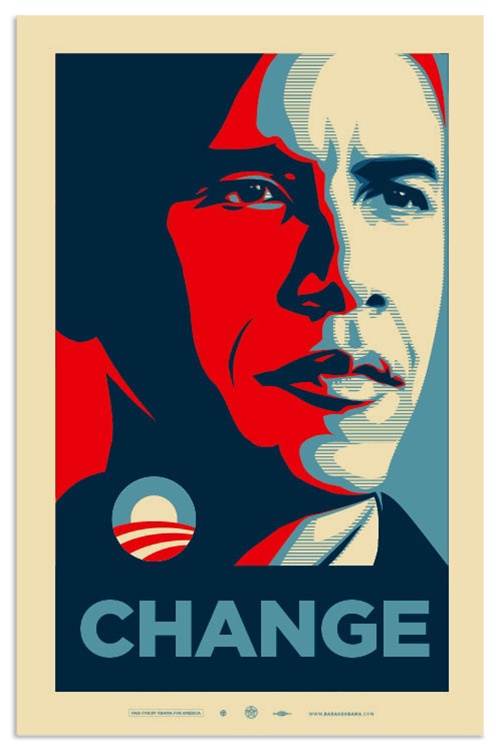
Above is the symbol for the Nation Recovery Administration, created in 1933 to combat the economic turmoil of the Great Depression. The NRA was a group established by the National Industrial Recovery Act, whose main goal was to create jobs in the country, as well as facilitate discussions between the government and business representatives in order to establish a system of fair trade. In the end, the NRA and NIRA were declared unconstitutional by the Supreme Court and deemed useless by the over 30% unemployed in the country and business owners who were losing money daily. During their time, The NRA launched a huge publicity campaign as a way to encourage businesses to follow the codes they established. A business that followed the codes posted the above flyer in their window or onto pamphlets, showing that they were following the NRA and helping the country to recover from the economic crisis. In reality, the NRA produced so many regulations that businesses were unable to do much of anything during this time, so buying from a company displaying the blue eagle might have meant buying from a company that was losing money. While this might have been the case, the real interest I have in this time period (besides for writing a decent history paper about it for my final) is the publicity and attempted branding of the NRA. The NRA posters kept reminding me of the Obama posters with change and hope written on them.


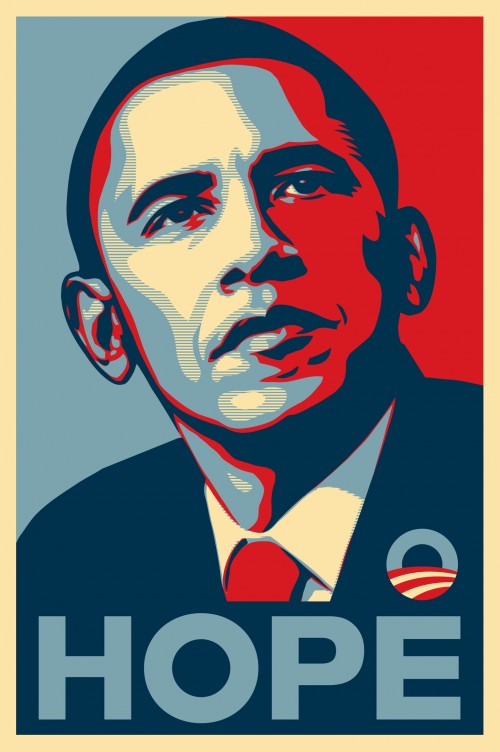
The above posters are beautiful works of advertising and branding. They show the American colors (the first one isn't supposed to look so purple, although purple is a mix of blue and red), and their simplistic message is one that every American can relate to. What's so powerful about the Obama and change connection is that it makes Obama a president for everyone. Everyone wants change, Democrats, Republicans, people pro-choice or anti-abortion. Obama and change aren't about him changing the effects of the Republican Bush, they're about changing the country, part of which is lifting the country out of an economic crisis that is starting to look somewhat similar to the Great Depression. At both of these times the country wanted evidence of improvement. Franklin Roosevelt, while a powerful president, did not inspire citizens as much has Obama does. He was certainly an active president, more legislation was passed in the first one hundred days of his presidency than was passed in the span of other president's entire four years, but he didn't look like change. Even 80 years ago visuals were more effective than verbal promises. Obama is African American, he's the first African American president in the United States. Roosevelt was white, wore glasses, and was in appearance just another Democrat and Republican. He certainly had a lot of public support, but his policies were what the public wanted to see in effect. They needed more than just the broad promise of change, they wanted to see that they'd be making money. Thus emerged the NRA and the rally to promote American spirit and support the NRAs goals, all while displaying the blue eagle brand.

For Americans now change seems to embody so much more than just economic change. Obama started his presidency by devoting much time to health care reform, which leads to a potential change in abortion policy, both things of moral, social, and political consequence as well as the inciters of fiery debate. Other changes to be made are to the economy. Many people are disillusioned with the new president because the economy is still failing, more and more people are losing work, and the health care bill has not even been passed. In some ways the Obama Change posters seem to have raised the public's expectations. The posters branded Obama in a special way, as they had to target the entire American public. Most products or businesses have a slightly narrower demographic to appeal to, but sure enough Obama had to target everyone age 18 to 114 (Gertrude Baines, World's Oldest Person, lives in LA and voted for Obama http://longevity.about.com/od/wholiveslongest/tp/worlds-oldest-person.htm, there's even a video of her voting at http://www.huffingtonpost.com/2009/01/02/114-year-old-gertrude-bai_n_154822.html).

What makes Americans so eager for physical proof of a promise for change? Maybe it's not just Americans. A tiny village in France named their town square after Obama. He represents a world-wide change in the way race is viewed not just in politics but in daily life. Over 50 percent of the United States voted for Obama as a politician and a person. They voted for him and his family, the way he lives his life, and proved that our country's majority isn't cripplingly racist, to the point where they can't elect a black president. I think a lot of people questioned whether the United States populace would really be able to do it, and Obama's election was based a lot on change, and his promise to bring change.

The Obama hope posters show another side of America. Americans are disheartened emerging from the Bush administration of war and economic tailspin. They need and want change, but they have hope. They're hoping that Obama will make changes. In some ways the hope campaign represents the skeptical nature of Americans, probably at high points after disheartening presidents such as Hoover (during the Depression) and Bush. Some Americans in 1930 were doing their part but were the others. The "We do our part," is a challenge of sorts, a I'm either counting on you to do yours to or I don't think you'll do it and it's depressing and sad and you're un-American. While the Obama Hope posters are a message saying that Obama has hope for the future and that you should feel hope when you think of Obama, the underlying doubtfulness of Americans seems to have a small part in these posters. In reality, America has little to be jaded to. Yes we've had too many bad presidents, yes we're all losing money and jobs, but we aren't dying of AIDS at astronomical rates like many people in Africa. We aren't under Mugabe's murderous command. Most of of us aren't impoverished. Of course it is incredibly important that those Americans who are living in extreme poverty receive representation in the government and attention, in general Americans have little to be truly disheartened over. However, we all have hope and Obama's campaign, that is still plastered to t-shirts and bumper stickers, shows an important aspect of modern politics. Obama seems to be a particularly branded president, what Americans want has been interwoven into his brand. His brand is luckily based on hope and change. When I think of Obama or see an Obama sticker I actually feel proud to be an American. I'm grateful to the American populace for being open to a necessary change. Even if Obama doesn't solve the economic crisis or reform health care, his election will always be a milestone in American history, at least for me. I haven't lost my job in the recession, O haven't had to withdraw from school because I can't afford it, and I'm looking at Obama from the perspective of someone whose advocacy of social reform reigns over all others. Also, I'm certainly too young to feel true embarrassment at being an American, as I've never lived in another country for more than a few months nor do I know enough about the world to really say that America isn't the place for me, but I shuddered amongst thousands when Bush pronounced nuclear and nuke u ler. I was a little embarrassed sophomore year when Exeter fans chanted "George Bush, George Bush," at us after we had made fun of their dress code. George Bush was president at a time when I was first starting to understand American politics, and most importantly, the issues plaguing Americans. I had no idea that monopolies were bad when I was six, I didn't know that there had been wealthy white men in the White House for years who favored giving large corporations the easy way to increased mega wealth while there were Americans struggling with poverty. When George Bush was elected President I was learning about these things, I had determined that they were bad, and I saw Bush doing the same things. In middle school my friends brother, a soldier in Afghanistan, died and left her family to cope in the country that had sent him there, and planned to send thousands of other sons and brothers to the same deadly place. Obama for me was a real change, one that would last and I'm wondering how the new media affected my perspective on Obama, my steadfast faith that Obama will change something. It leads me to wonder how the new media is affecting politics. I know that newspapers and television stations have all in the past had immense influence on the way the public viewed politicians. How do things such as Facebook, Myspace, Skype, and Google affect the branding of politics. Bumper stickers and t-shirts have been available to campaigns for years, but the Obama t-shirts and bumper stickers represent a great trend that is spreading across new media sources.

Would Google ever risk tracking a person's political affiliation and advancing say Obama articles if someone searches "election of 2012?" Will corporations, now able to spend as much as they want on political campaigns, pay companies such as Facebook to advertise a certain campaign candidate? How did the new media portray Obama and McCain and how great was their effect on Obama's rise and McCain's downfall. Was the branding of Obama as an initiator of change, a beacon of hope, literally glowing with white light in his posters, influenced greatly by social networks and our ability to find out as much as we wanted about candidates. Is new media helping us to make better choices, as we're more informed, letting us choose the right candidate?