Saturday, January 30, 2010

The State of Celebrity Diet Crazes 2010


I was searching for more information on Obama's State of the Union address when I clicked on an article on news.yahoo.com. The title, "FACT CHECK: Obama and a toothless commission" was devoted to disproving claims by Obama or drawing attention to flaws or mistruths within them. The article seems silly to me as I doubt these reporters really know what they're talking about. It frustrated me to see Obama quotes and then rebuttals underneath titled The facts. The facts the article states seem less like facts and more like longwinded approacesh at twisting Obama's words. They make flimsy, weak statements such as "Any commission set up by Obama would lack authority to force its recommendations before Congress, and would stand almost no chance of success." Using the words would and almost in one sentence automatically limits the author's authority. I read to the bottom of the "dialogue," and frustrated, scrolled up slowly trying to dissect why I felt that these reporters were rather sleazy. On the side of the article were a variety of advertisements and sponsored links. There was an ad showing an annoyed woman, half naked, holding a pillow over her ears, called "How to Cure Snoring Once and for All." The naked picture attracts the readers attention, but its content was of little interest. A few ads down was one titled, "Hollywood's New Secret...How to Convince the Brain to Stop Over-Eating. Yikes a million. This ad draws the reader in way too easily. The words secret, and stop over-eating would probably attract many Americans looking for a new trick for weightloss. Before clicking on the website I thought about the statement "convince the brain," and how ridiculously silly it is.

While its silly, the articles title makes it sound as if knowing one little secret will allow for the brain to be convinced to do something extraordinary. I clicked on the article and a new title emerged - "Hollywood's New Diet Secret...Appetite Control." Appetite control? Haven't we all known that controlling our appetite, watching what we eat and eating healthy are ways to stay thin? I've been told a million times that eating breakfast allows your body to regulate its calorie needs for the day. The article's first paragraph accuses the press of putting pressure on stars to stay thin, establishing themselves as an honest "anti-tabloid" site looking to help people out. The article advertised "Sensa" a weightloss product, of "odorless and tasteless food crystals," that people are supposed to sprinkle on their food to change the way their body reacts to smells and tastes, and control appetite. The article then follows up with an extra plus to the product, besides for ultimate thinness, "Best of all, Sensa contains no stimulants or fat-blockers, so there are no unpleasant side-effects." No side effects? Putting chemicals on one's food leads to no side effects? What about the fact that you have to eat a weird textured crystal mixture on your food? Is tricking your brain into not craving certain foods really not a side-effect? That is absolutely not healthy. Also, there are many other ways to control one's appetite without foul chemicals. The article at the bottom stated that since the company knew people would be skeptical to use the product as so many weightloss products are useless, they are offering a free trial. Well that's super, but what if the product doesn't work with the free trial? What if it works for a month before your hair falls out and you get hospitalized for nutrient deficiencies? Our bodies' cravings and hunger signals mean something, and tampering with them with chemicals is silly. I understand the reasons behind gastric bypass surgery and weightloss programs that design meal plans such as Weight Watchers or Jenny Craig. These programs might not be healthy for everyone, but at least they put emphasis on portion control and eating healthy rather than eating fake chemicals.

The article boasted that the program allows one to eat whatever they want, that the chemical will control cravings and prevent a person from feeling starving. For how long will it work and how much of a person's cravings will it control? If it controls a person's cravings for chocolate but not for icecream, couldn't that person end up the same size after following the program? Also, when was the last time we Americans only ate when we were "starving," not only is that use of adjective in an advertisement shaky, as true starvation would not be reached if the person using the crystals would be able to eat as much as they want, but we eat when food is around, when we feel like it. Does the crystal chemical account for food cravings linked to depression or having a bad day? How does it prevent us from eating whenever, not just when we're hungry?How, in fact, does the chemical even work? The article gives no explanation and the program's website offers even less information. How do these companies expect us to trust this product? Are they relying on our constant fight for a new weight or body? Are they assuming that a desire for thinness will surpass our critical reasoning or basic investigative skills? As a final thought, what kind of a website is www.howlifeworks.com? This website acts as a cure-all, an all-knowing body there to guide us lost, confused little humans. Other titles of articles available on the site are, "Owning a Franchise is Easy." Is it really easy? Another is "How to get a Free Audiobook and Start Enjoying Great Literature Again? At what point did we become illiterate or unable to appreciate classics? The whole site is phony, yet they appear to actually have something to offer, as they toot partnerships with fancy scientists who study weight-loss. It's silly that there's one website like this out there but how many more are there? Most likely far too many!


The product's website is: http://start.trysensa.com/dms1420/

Friday, January 29, 2010

"Vitamin" Water


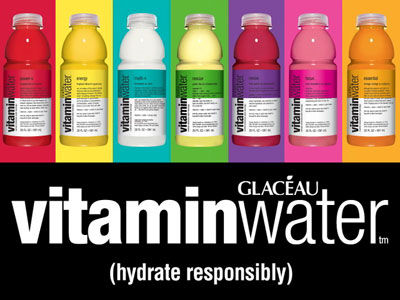
In the past few years water infused with vitamins and fruit flavors has become all the rage. In fact, a lot of my friends rely on these waters as a source of nutrients in their busy days or they rely on the comfort drinking vitamins brings them. If you read the label of a water fortified with vitamins it rarely has more than vitamin C and often contains tons of sugar or a sugar substitute such as sucralose. Your body needs no more than 100 percent of a daily dosage of vitamin C, so drinking a water with over 100 percent vitamin C is silly and unproductive. The companies have marketed these products very well and I have easily fallen prey to their charms and bright colors. I love Vitamin Water, produced by the Glaceau water company, recently bought by Coca Cola. I've tried every single flavor, ranging from blueberry-pomegranate to jackfruit-guava. I did not even know what a jackfruit was until drinking the jackfruit flavored Vitamin Water and googling the fruit. Apparently they grow in India and are popular in Brazil (http://www.crfg.org/pubs/ff/jackfruit.html). Vitamin Water mixes exotic fruits in exotic combinations that make the water seem ultra-special. The Vitamin Water website appeals to those of us who want to make our lives less complicated and relaxed. As the page loads, text reads "We'll spare you the cheesy on hold" music. Until taking Media Studies I visited the Vitamin Water Site and felt happy that they were saving me from seconds of some awful music. I completely bought into their "we're helping you out vibe," and by the time the page loaded I was ready to see the new flavors. Now I'm wary of the company as I find myself analyzing the ads I'm attracted to and the way advertisers hook people like me in. In fact, I like listening to music, and the loading process of vitaminwater.com is quite long and boring without music to listen to. Lucky for the advertisers, Vitamin Water has a wonderful flavor, and they're marketing truly tasty stuff. While the flavors are great, the advertising is what makes me go back every time for a newly released flavor, as their ads are very bright and in you face. I rarely miss them.

Another interesting marketing tactic they employ is the nouns they assign their waters, intangible things the water is supposed to bring a drinker. The raspberry-apple flavor is "defense," and there's a peach-mango one titled "endurance." It's ridiculous to believe that a water can assist in building up endurance, especially one fortified with vitamin e and ribose. Ribose is a sugar, and the bottle boasts sustained energy, when in fact drinking liquid sugar before a workout can lead to energy crashes. It's a big stinky fib, not quite a lie, yet certainly not a truth. Another hilarious little thing I noticed as I perused the website was the nouns associated with two flavors they have, one is b-relaxed, and the other is tranquilo. Tranquilo in spanish means calm, so by using essentially the same word in another language they have rendered their water exotic and themselves, in my mind, uncreative. They then dye the water bright colors, and it is truly special. Vitamin water ads also permeate the internet, at least many of the sites I access. It probably wasn't hard to track a vitamin water addict like me down via cookies, but I still find myself seeing disproportionate numbers of of vitamin water ads. It might be that I notice these ads more often, as they always use bright colors and blocky, flashy fonts.

The Vitamin Water craze seems to fit into a larger vogue water and vogue health food trend. Vitamin Water advertisements amalgamate the glamour of an alcohol commercial with the health benefits of an organic food item. The bright colors and flashy signs evoke vodka ads, pushing Cosmopolitans and other fancy drinks. These ads appeal to young twenty somethings striving to lead glamorous lives, filled with exotic drinks. The fancy flavors fit both in the alcohol category of making the audience feel as if all the flavors in the world are available to them, while the blurbs about health and wellness adorning every Vitamin Water bottle are very similar to those on health foods. The Odwalla Company has very similar blurbs about the power of the ingredients used to promote good health and wellness. Health foods are becoming more and more glamourous. Vitamin Water appeals to the young crowd who occupy cities and strive to live a life of exoticism and glitter, and the young crowd who wants to live close to the earth, and drink fruit infused waters. My mom is a cosmetic surgeon, and works often with city-dwelling wealthy women who live extremely privileged and glamorous lives. She always has a vitamin water display in a rainbow of colors, similar to the one above, so her customs can drink the water of young people while having procedures done to make them look younger. Underlying all Vitamin Water ads seems to be that laid back, I'm caring for myself without having to eat a salad, kind of vibe. They appeal to the side of us all that just wants to be chill and cool and nonchalant.

Companies like Vitamin Water, which market a very specific thing, interest me greatly. I wonder how they choose the demographic they will advertise to. Do they study advertising and market trends of past products that are similar? Do they practice trial and error, rolling ads until one of them sparks an increase in sales? I can try to pinpoint the type of people who would be interested in Vitamin Water by looking at the ads and interacting with people who consume it, but how did Vitamin Water know who exactly would be interested and how to get their attention? The company appears to be growing, as they release new flavored waters often. Coca Cola bought Glaceau in 2007 for 4.2 billion dollars (http://www.nytimes.com/2007/05/26/business/26drink-web.html), which alludes to some success in the company. Under such a powerhouse as Coca Cola, Glaceau and Vitamin Water seemed to have grown. As they've grown I've noticed that their flavors have gotten fancier and fancier. At the beginning they had lemonade, fruit punch, and grape, and now they have fruits I've never heard of, and I'm a major fruit lover. The company seems to be moving rapidly in the direction of the exotic and the cosmopolitan, and I wonder what has sparked them to do that. What types of people have responded to their ads, besides for girls named Anneke who go to prep school in Massachusetts?

In the Aftermath of Haiti

Tuesday, January 26, 2010

In the Aftermath of Haiti

Information on Haiti is hard to find on the web now, specifically on newspaper sites. It's there, but it's hidden behind stories about the Celtics and Toyota recalls. On the New York Times' website the only information is in a tiny print, and shows links to pictures and a special-interest story titled "Girls' Rescue From Haiti Expands Family by Two..." The picture above the caption shows a man and Haitian girl embracing in a manner evoking familial love and care. Within the article a variety of pictures can be found, such as the one above. The article tells the story of a family who has been working for three years to adopt two children, Bettania and Dieunette, from Haiti. Dieunette, shown above, had come to the United States for a brain surgery, funded by the Heaton family, and had then returned to a mother in Haiti who was struggling to care for her daughters. A hurricane in 2008 prompted their mother to put them up for adoption, and the Heaton family immediately volunteered to adopt the sisters. The mother, Kristin Heaton (shown above), visited Haiti every 3 months for over a year to check on the two girls, until the earthquake. The family waited for days for news of the girls, until receiving a text message with the word "alive," from the orphanage. In the days that followed a rescue mission brought the girls and many other children from orphanages to the United States, where visa requirements for Haitian orphans who had been close to being adopted pre-earthquake, had decreased. The girls were in Nebraska within a week of the Hurricane where they met their new family. They were in poor health, Dieunette had a tape worm, but are continuing to get healthier.
In general, the whole story is heartwarming, yet it makes me question what news about Haiti should focus on at this time. The article warns that over 10,000 children are predicted to have been orphaned in the earthquake, but gives no information on adoption or other means of saving them. I appreciated the beautiful story as I love to hear about happy endings like us all, however I'm confused about why exactly this story was printed and what purpose it serves. The motives of the New York Times seem to focus less on drawing attention to Haiti and more on drawing attention to the newspaper itself and its focus on happy, peaceful stories. If the latter covers the Times' motives is that inherently bad? Is any attention to Haiti good attention, as it creates awareness? Maybe the New York times is doing Haiti a favor by writing stories that will attract readers and bring awareness. I'm wondering if there are stages that the media follows before changing the direction they view an international or national disaster or crisis. Is there a certain time in which they report mostly facts (or what they perceive to be or call facts) and information on the reaction of the world, before transitioning to individual stories that appeal to the teddy bears in us all, looking for a happy ending? Does the media's take on an event in the aftermath depend entirely on the crisis and they way the world is viewing it? Would pictures of the sustained devastation make Americans depressed and less likely to take action to help or is the media worried about the advertising filter and rendering Americans depressed and unlikely to buy? In general, I'm wondering why the only information on Haiti is about Haitian children in America, and just two children at that. Why aren't we seeing more pictures of children abandoned, children who need homes, and links to donating to orphanages? Why aren't we seeing links to the Red Cross and other organizations that can help the thousands of girls and boys out there that haven't been so kindly taken in? Are newspapers concerned that if a person donates to Haiti relief they won't spend money elsewhere, such as with their advertisers? Why has the media seemed reluctant to make more of a difference? Would it be against the Code of Ethics for a journalist to display the opinion that it is good to donate to victims of natural disasters? Does this avoidance stem from something deeper in the media complex? How do filters such as advertising and sourcing play into the way in which newspapers such as the Times display information on disasters like the earthquake?