
Most of the postcards from the era looked something like this. This one lacks the scripture, but it remains simple and delicate. It's not flashy, and emphasis is placed on the correspondence on the back as the front isn't particularly striking or interesting.
I wasn't capable of finding any postcards from the 1930s, but I did find a lot from the forties and fifties. As time went on the cards got flashier, probably as the materials and technology used to make them improved, but this development also matches the way the times were changing. In the forties the postcards focused on landscapes or structures. They didn't display many people or things, but showed beautiful images. As time went on the images became more and more suggestive. I remember our talk about misrepresentation of teenage sex in the fifties. At this time teenagers were having sex just like teenagers today, but it seemed less talked about. Personal affairs such as these were covered up. Public exchanges between people, such as those on postcards, stuck to emotionally dry or neutral images, as to cover up what was really going on. Of course this could be a conspiracy theory of sorts, but what do we use postcards for? We use them to show people where we are and what we're doing. Rarely are postcards sent to people purely for their enjoyment. If we send stunning images of the Virgin Islands all around the world to our friends, were suggesting something about our lives. The postcard might just show a few islands suspended in an ocean image, but what those islands mean goes so far beyond blue and green shapes. Tropical drinks, suntans, water sports, and gourmet foods all lie beneath the images. In the forties and fifties, images seemed to be used as suggestion, similar to how we use postcards today, but the images today incorporate people and material things, allowing them to suggest even more about our lives. Postcards aren't like greeting cards. They rarely have more writing than a scrawled "Florida," or "The Cathedrals of Spain," adorning them. The images are what count.
As time went on the images in the postcards became more and more suggestive. A postcard of the Bahamas in the forties showed people looking at a waterfall, the same postcard in the 1980s might show those people clad in fancy swimsuits and holding fancy drinks. Sunhats are replaced by sunglasses, and long pants and dresses by two piece swimsuits. The general message, however, is the same throughout the ages. The Bahamas are beautiful and fun and the people experiencing the waterfall are having the time of their lives. Postcard makers get to dictate what exactly we reveal about our lives to our friends. They dictate just how much decadence is evident in a postcard, just how expensive the hotel looks. They dictate how fluffy the snow looks on a postcard of a mountain. In a world of infinite suggestions, a postcard maker decides just how much will be visible and how much will be left to the imagination of the receiver.
The images on postcards we send to friends and family often seem to affect the way they view a trip of ours more so than what we write on the back. Postcards are so short that most of what is written has to be superficial and explanatory, ie. "We're having a great time in the sun. So far we aren't too sunburnt but we have gained weight from the buffets!" This is a generic message, and while it suggests something about the trip, that there is a lot of sun and a lot of food, it suggests little about where the trip is or how it's really going. Gaining weight stinks, but an image of a beautiful person sitting on a beautiful beach speaks loudly and says, "This rocks." I would send this message (the one above) to almost all of my friends and family, but I would pick specific images to send to certain friends and family. I might send best friends a different postcard than a friend I'm in touch with but not completely open with. There are a lot of factors that would go into what type of postcard I sent, and how much it might reveal about my life. If I was sending a postcard to someone I knew hadn't travelled much in their life but really wanted to, I'd probably send a postcard with something more interesting on it and less insanely decadent than a seascape and villa such as this:
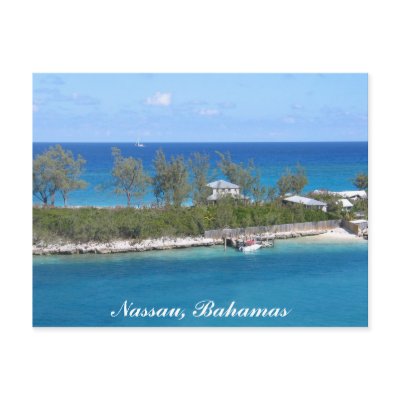
This postcard is beautiful, but very revelatory. It shows off a fancy and expensive looking house, and boasts a life or vacation in a beautiful place. It's revealing in some regards, and subtle in others. Postcard creators give us the different views on a place or a situation that we distribute to the many different types of people in our lives. Postcards might just seem like a little thing that you send as a hello of sorts, but they are infused with so much more meaning. Maybe I'm the only one who notices the subtle hints, but I think seeing postcards from different decades made this pattern more distinct. It clarified the subtleties in postcards, the little things that might not seem significant but which change the feel of a postcard completely. Would postcards be considered part of the media? They certainly change the way we communicate with one another and the way we view different places or structures or families or people or lives. In some cases, postcards create an entire image of a place for someone. I've never been to Colorado, but a friend sent me a postcard from Aspen this past winter. Now, whenever I think or hear about Colorado, the only reference I have is a smiling family clad in matching ski gear at the top of a mountain. I know there's so much more to Colorado than just family vacations and skiing, but the image is forever engrained in my head.

No comments:
Post a Comment