I was looking at People.com today and found a perfect example of this dichotomization. In this case the media has drawn attention to their constant draw towards dichotomization. There was a photo album titled "Good Girls with Tattoos." People magazine started by placing these women into the category of "good," and then proceeded to point out the one thing they had in common that was particularly surprising and "bad". They act as if this mix of good and bad is a huge surprise, something completely unique to these 10 celebrities. There are only a few good girls out there that have tattoos. Also, it surprised me to see People so failingly grasp for some semblance of an interesting album. Tattoos mean completely different things for each tattooed person. One of the women, Alyssa Milano, has a tattoo of a cross on her shoulder. Does that really compare to the "Nine" Eva Longoria has tattooed to her neck or Julia Robert's children's names. All of these tattoos are relatively mild and if People.com is so eager to show that these good girls are having a bad streak, they aren't doing a very good job. What's so disappointing about this article is how eager I was to look at it. For starters, I find tattoos really interesting. It's interesting to know the reasons behind people's tattoos or try to deduce their meaning on my own. Anyways, these types of faux stories catch one's eye. The whole good girl violating that reputation draws our attention. We're so programmed to think of these celebrities in this way and we forget to even realize that these "good" girls are not just good. They aren't just bad. They're a mix, yet we're eager to put them into one category, and excited when they violate their reputations.
Another dichotomization that's interesting to see in the media is that between friends and enemies. When a couple breaks up the first thing People does is dissect the causes behind the split. Are they angry at one another? Was it mutual? What went wrong? Friends who fight are immediately labeled "frenemies," and friends that escape public critique of their relations are best friends forever or "bffs." People.com has a photo album dedicated to the famous friend pairs out there. The whole thing seems silly, so why do we buy into it so readily? Why do we sometimes demand the categorization of the women and men we look up to?
Each age group and socioeconomic group and gender probably has its own reasons for being attracted to the classification of celebrities in the news. Speaking from the perspective of a white eighteen year old female who goes to Andover, lives in the Paul Revere dorm, and takes Ms. T's media studies class, it seems I'm attracted to it because I feel my life would be simpler if I could easily be placed in a category. Life might be dull in this case, but it seems it would be easier to deal with. Making the choice of what college to go to has emphasized this feeling. If I was a preppy person I might choose one school. If I was just into environmental studies I might choose another school. All these schools have reputations that put them into one category or another and peg them against other schools. Pomona clashes with Harvard. One's "artsy" one's I don't even know how to describe Yale's reputation. If I fit the "artsy" category and knew it, maybe making college and other decisions in my life would be easier. Maybe not. Maybe only I find classification of other people's lives therapeutic in a way. It's gross to find relaxation in watching other people be stereotyped and in some ways marginalized and following their marginalization. These celebrities are barely themselves any more. They don't matter, only their images and publicity matters, yet I find it hard to keep my eyes from glimpsing at these stories and photo albums.
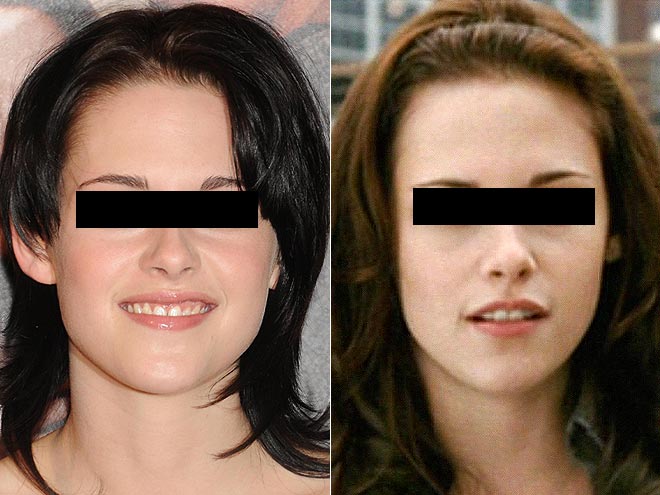
Above is a quiz on People.com that asks readers to distinguish between the actress Kristen Stewart and her character Bella Swan. It really interests me that People has all but convinced its readers that there's actually a difference between the two. Sure, Bella Swan is a fictional character created by the writer of Twilight, but the Bella Swan in Twilight is still Kristen Stewart. Kristen Stewart, while maybe not the most adept actress out there, still made Bella Swan a part of herself. There's no difference between the actress and the character in the movie. Sure the actress and the character in the book are different, but that's because they're completely different human beings. They weren't related until Kristen Stewart signed on to put her own spin on the character of Bella, and bring her to life. People.com "forgets" to mention that Bella Swan is not real. They ask "Which brunette beauty has matching brown eyes." They both do silly. They're completely the same person. While our society likes dichotomizing different people and things, Kristen Stewart is a different person entirely from Bella Swan, they also want to link people together. Everyone's excited when two completely different celebrities start dating or they star in a movie together. We want to know that people who are completely different, or who the media pins as completely different, can come together and function. Bella Swan and Kristen Stewart are sooooooo similar! It's so funny and so great that the actress is so much like the character. Nevermind the fact that one's real and one's fake.
Do we hope that we'll meet people completely different from us and create some epic story? How does our desire to watch disparate individuals interact and meet one another get portrayed in television? Movies? How often does our desire to watch two opposite souls become one influence the truth we are given by the media? The gossip magazine industry is notoriously of dubious integrity, but to what extent is what we know about celebrities truth, speculation or just straight up lies? Of course there are a million more layers to celebrities than we as their followers and the American public never view, but are the layers we see accurate at all? I guess this leads me to ask, are celebrities figments of our imaginations. Are they beautiful bodies with photoshopped souls pasted onto them? Can we learn more about them from watching a celebrity act in a movie or television show than we can by seeing pictures of them as themselves in gossip magazines. To what extent are we contributing to the corruption and degradation of our news system and will the news every be free from public influence and will we ever be free from the news' influence. Will we ever be able to truly develop our own observations and opinions of a certain actor or singer before seeing them pasted across a magazine cover while checking out at Whole Foods. Even places that boast being havens for people wishing to get back to nature, display magazines such as People. Will we ever break free from the gossip magazine section of the news and will the gossip magazine section of the news ever break free from us. For them breaking free of public desire and demands means destruction, giving their livelihood up to journalists who don't want to write rumors but want to write truths. Will it ever happen?

No comments:
Post a Comment