
Above is the symbol for the Nation Recovery Administration, created in 1933 to combat the economic turmoil of the Great Depression. The NRA was a group established by the National Industrial Recovery Act, whose main goal was to create jobs in the country, as well as facilitate discussions between the government and business representatives in order to establish a system of fair trade. In the end, the NRA and NIRA were declared unconstitutional by the Supreme Court and deemed useless by the over 30% unemployed in the country and business owners who were losing money daily. During their time, The NRA launched a huge publicity campaign as a way to encourage businesses to follow the codes they established. A business that followed the codes posted the above flyer in their window or onto pamphlets, showing that they were following the NRA and helping the country to recover from the economic crisis. In reality, the NRA produced so many regulations that businesses were unable to do much of anything during this time, so buying from a company displaying the blue eagle might have meant buying from a company that was losing money. While this might have been the case, the real interest I have in this time period (besides for writing a decent history paper about it for my final) is the publicity and attempted branding of the NRA. The NRA posters kept reminding me of the Obama posters with change and hope written on them.

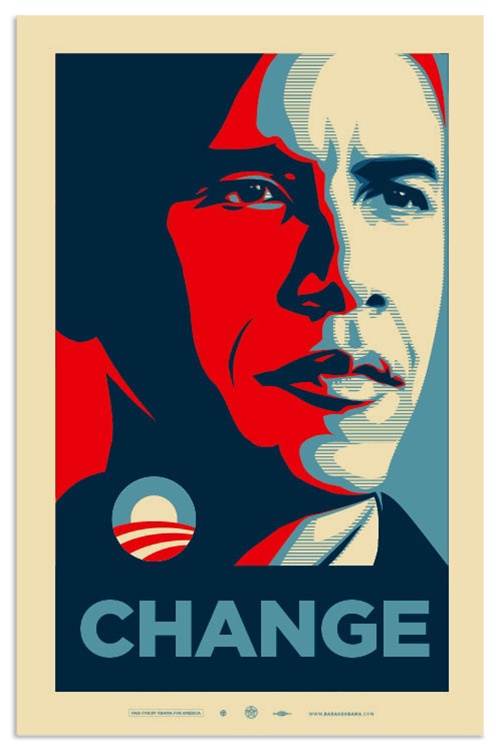
The above posters are beautiful works of advertising and branding. They show the American colors (the first one isn't supposed to look so purple, although purple is a mix of blue and red), and their simplistic message is one that every American can relate to. What's so powerful about the Obama and change connection is that it makes Obama a president for everyone. Everyone wants change, Democrats, Republicans, people pro-choice or anti-abortion. Obama and change aren't about him changing the effects of the Republican Bush, they're about changing the country, part of which is lifting the country out of an economic crisis that is starting to look somewhat similar to the Great Depression. At both of these times the country wanted evidence of improvement. Franklin Roosevelt, while a powerful president, did not inspire citizens as much has Obama does. He was certainly an active president, more legislation was passed in the first one hundred days of his presidency than was passed in the span of other president's entire four years, but he didn't look like change. Even 80 years ago visuals were more effective than verbal promises. Obama is African American, he's the first African American president in the United States. Roosevelt was white, wore glasses, and was in appearance just another Democrat and Republican. He certainly had a lot of public support, but his policies were what the public wanted to see in effect. They needed more than just the broad promise of change, they wanted to see that they'd be making money. Thus emerged the NRA and the rally to promote American spirit and support the NRAs goals, all while displaying the blue eagle brand.
For Americans now change seems to embody so much more than just economic change. Obama started his presidency by devoting much time to health care reform, which leads to a potential change in abortion policy, both things of moral, social, and political consequence as well as the inciters of fiery debate. Other changes to be made are to the economy. Many people are disillusioned with the new president because the economy is still failing, more and more people are losing work, and the health care bill has not even been passed. In some ways the Obama Change posters seem to have raised the public's expectations. The posters branded Obama in a special way, as they had to target the entire American public. Most products or businesses have a slightly narrower demographic to appeal to, but sure enough Obama had to target everyone age 18 to 114 (Gertrude Baines, World's Oldest Person, lives in LA and voted for Obama http://longevity.about.com/od/wholiveslongest/tp/worlds-oldest-person.htm, there's even a video of her voting at http://www.huffingtonpost.com/2009/01/02/114-year-old-gertrude-bai_n_154822.html).
What makes Americans so eager for physical proof of a promise for change? Maybe it's not just Americans. A tiny village in France named their town square after Obama. He represents a world-wide change in the way race is viewed not just in politics but in daily life. Over 50 percent of the United States voted for Obama as a politician and a person. They voted for him and his family, the way he lives his life, and proved that our country's majority isn't cripplingly racist, to the point where they can't elect a black president. I think a lot of people questioned whether the United States populace would really be able to do it, and Obama's election was based a lot on change, and his promise to bring change.
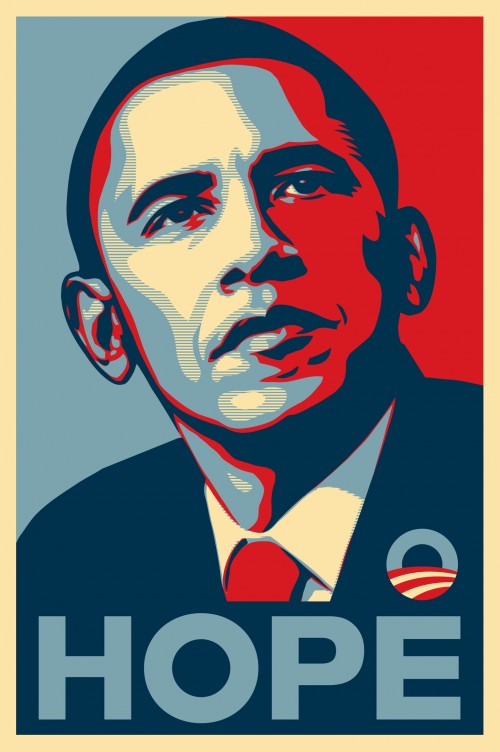
The Obama hope posters show another side of America. Americans are disheartened emerging from the Bush administration of war and economic tailspin. They need and want change, but they have hope. They're hoping that Obama will make changes. In some ways the hope campaign represents the skeptical nature of Americans, probably at high points after disheartening presidents such as Hoover (during the Depression) and Bush. Some Americans in 1930 were doing their part but were the others. The "We do our part," is a challenge of sorts, a I'm either counting on you to do yours to or I don't think you'll do it and it's depressing and sad and you're un-American. While the Obama Hope posters are a message saying that Obama has hope for the future and that you should feel hope when you think of Obama, the underlying doubtfulness of Americans seems to have a small part in these posters. In reality, America has little to be jaded to. Yes we've had too many bad presidents, yes we're all losing money and jobs, but we aren't dying of AIDS at astronomical rates like many people in Africa. We aren't under Mugabe's murderous command. Most of of us aren't impoverished. Of course it is incredibly important that those Americans who are living in extreme poverty receive representation in the government and attention, in general Americans have little to be truly disheartened over. However, we all have hope and Obama's campaign, that is still plastered to t-shirts and bumper stickers, shows an important aspect of modern politics. Obama seems to be a particularly branded president, what Americans want has been interwoven into his brand. His brand is luckily based on hope and change. When I think of Obama or see an Obama sticker I actually feel proud to be an American. I'm grateful to the American populace for being open to a necessary change. Even if Obama doesn't solve the economic crisis or reform health care, his election will always be a milestone in American history, at least for me. I haven't lost my job in the recession, O haven't had to withdraw from school because I can't afford it, and I'm looking at Obama from the perspective of someone whose advocacy of social reform reigns over all others. Also, I'm certainly too young to feel true embarrassment at being an American, as I've never lived in another country for more than a few months nor do I know enough about the world to really say that America isn't the place for me, but I shuddered amongst thousands when Bush pronounced nuclear and nuke u ler. I was a little embarrassed sophomore year when Exeter fans chanted "George Bush, George Bush," at us after we had made fun of their dress code. George Bush was president at a time when I was first starting to understand American politics, and most importantly, the issues plaguing Americans. I had no idea that monopolies were bad when I was six, I didn't know that there had been wealthy white men in the White House for years who favored giving large corporations the easy way to increased mega wealth while there were Americans struggling with poverty. When George Bush was elected President I was learning about these things, I had determined that they were bad, and I saw Bush doing the same things. In middle school my friends brother, a soldier in Afghanistan, died and left her family to cope in the country that had sent him there, and planned to send thousands of other sons and brothers to the same deadly place. Obama for me was a real change, one that would last and I'm wondering how the new media affected my perspective on Obama, my steadfast faith that Obama will change something. It leads me to wonder how the new media is affecting politics. I know that newspapers and television stations have all in the past had immense influence on the way the public viewed politicians. How do things such as Facebook, Myspace, Skype, and Google affect the branding of politics. Bumper stickers and t-shirts have been available to campaigns for years, but the Obama t-shirts and bumper stickers represent a great trend that is spreading across new media sources.
Would Google ever risk tracking a person's political affiliation and advancing say Obama articles if someone searches "election of 2012?" Will corporations, now able to spend as much as they want on political campaigns, pay companies such as Facebook to advertise a certain campaign candidate? How did the new media portray Obama and McCain and how great was their effect on Obama's rise and McCain's downfall. Was the branding of Obama as an initiator of change, a beacon of hope, literally glowing with white light in his posters, influenced greatly by social networks and our ability to find out as much as we wanted about candidates. Is new media helping us to make better choices, as we're more informed, letting us choose the right candidate?

No comments:
Post a Comment