There was a trivia of "Guess the Oscar Dress!" and "Oscars' Baby Bumps," all displaying images of celebrities dressed up for the show, many of whom have never won nor have a chance of winning (haven't been nominated) this year. What interested me most was their "Predict the Oscar gown,"challenge. It struck me, scrolling through the pictures of celebrities and dress possibilities for them, how much goes into branding a celebrity, especially how much stalking goes into the branding of a celebrity! Each of the women featured, Penelope Cruz and even Miley Cyrus who has no place presenting at the Oscars as she's an actress on a teeny bopper Nickelodeon show, had a brand associated to them. The gowns chosen as possibilities for them were chosen based on studies of their gowns over the past few years, the jewelry they've worn, the colors they've choosen. These celebrities have been pinned as the cute Southern Girl, the hot Latina, the "mature" children's show actress. It's all there on the site, details of their pasts, and their future! Their brands have taken them to a point where the creators of People are creating a future of sorts for them, based on all the branding they've been subjected too over the course of their fame. What's even funnier is that most celebrities have publicists and stylists that shape their brand for them. They have agents who choose movies. Their brands, based on the littlest things such as how much money they earn per movie, are all manipulated. They're all pretty much fake!
I suppose it's like advertising for Nike if you're a shoe vender. If your business is based on celebrity gossip, you better be advertising the celebrities, even those that aren't the most consequential at the time (those who aren't nominated or aren't even actresses). Even if Nike has a brand new type of shoe, many vendors advertise all of their old shoes too.
How has new media changed the branding of the female celebrity, the way she is approached by the media during times when her career as an actress/singer and a fashionista is being scrutinized and the scrutinization is being funneled into a brand name and image? This year is the 82nd Academy Awards. How has each year, each new technology, each change in the way technologies are used, changed the way celebrities are viewed around this time? Branding of a celebrity has many levels and many influences. A female celebrity's family life, her style choices, her acting career, all go into her overall brand, and during this time, the Oscars, each aspect of her life is examined. Brands are added to each year, they're enforced by years of emphasis on certain aspects of a celebrity. New media seems to allow all these aspects to be compiled, and studied together over the course of many years, the ones that seem most defining or are made most defining by a tabloid or a certain event, emphasized further. A celebrity's brand is years thick, reinforced with new pictures and commentary every year. People.com also has a "Cursed! From Oscar to Split," section showing couples who were present at the Oscars together, but now are broken up. Another section is the "Which Couple Should Make Their Red Carpet Debut Oscar Night?" poll. Couples are starting to be branded together. Eva Longoria Parker and her NBA playing husband carry a significant brand, based a lot on the fact that she's about 5'2" and he's at least 6'2." Images of them together at shows such as the Oscars go into their brand, and every year their size difference is emphasized, showing that they are a branded couple who defy height discrepancies trying to keep them apart! In fact, their different heights, according to the media, represent the way they balance one another out, making them the perfect couple. The Oscars is the time of ultimate branding, so how has the branding changed?
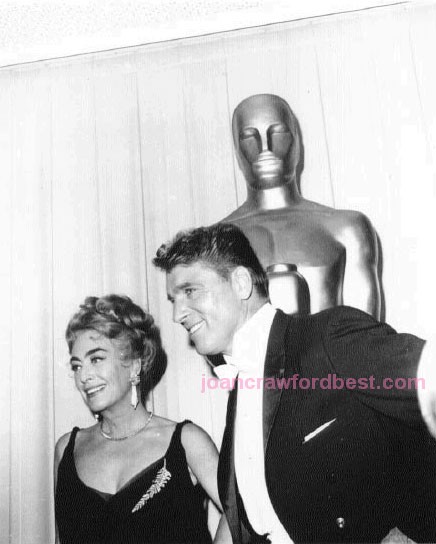


In the 30s Joan Crawford and Bette Davis were famous, the forties, Lucille Ball, Katharine Hepburn, Veronica Lake, Vivien Leigh, and Ava Gardner. Grace Kelly, Marilyn Monroe, Kim Novak, Brigitte Bardot, and Elizabeth Taylor all held the attention of audiences and the media in the fifties. So many celebrities have been in the spotlight for the past ninety years! How has the media changed in the way they brand them? How did the Oscars and award shows contribute to celebrity branding during the 20s and 30s and 40s. The 50s and 60s? Were celebrities less branded back then, when brand names were less emphasized than they are now? By the sixties, at least, celebrities were definitely starting to carry brand names that have lasted through the millennium and continue to hold strong.
Above is Joan Crawford at the 1962 Oscars, after her time in the spotlight, but warranting attention all the same. She looks regal, classic, and many of the sites I looked at boast her time-defying beauty.
Olivia de Havilland won best actress in 1946 (above). Vivien Leigh (below) won best actress for Gone with the Wind in 1939.
The photos are in black and white, they show women wearing different styles, but they are all in the spotlight. They were all subjected to the media's spin on their apparel and the awards they won. While looking for these photos I found little commentary on the actresses from the time of their fame. This probably has a lot to do with the technology the media had access to at the time. The articles I did find placed more emphasis on the awards and the movies the actresses were in, their actual careers, rather than the fashions they were sporting. Also, the coverage of their lives, their families and boyfriends, was much less emphasized.
Has the new media single handedly transformed celebrity branding into a spectacle where everything is known and public about celebrities? Of course new media has subtracted from privacy and augmented gossip, but to what extent? How has it changed the gossip being discussed? Has a shift in values in American society created a fascination with knowing everything about our favorite movie stars, with the new media just serving as vehicle for playing out these values?
Marilyn Monroe's rumored 1960s affair with JFK was scrutinized by the public and the media. She was criticized for a "sexy" birthday song she sang to him around the time of their apparent affair. While Marilyn Monroe was considered seductive and the ultimate womanly woman, Audrey Hepburn was praised for her beauty too, both of them living at the same time and occupying the same media sphere. They have completely different brands. Hepburn is considered lady-like, giving (she was greatly involved in UNICEF efforts), traditional, while Monroe is considered daring, defying the time she lived in by emphasizing her sexuality and body.
Looking for pictures of these women at the Oscars, I stumbled upon a website (sodahead.com?) that seemed like a dubious information provider, but had started a debate as to who was more naturally beautiful Audrey Hepburn or Marilyn Monroe. This type of media attention must have followed the two girls around throughout their careers. When I googled Marilyn Monroe and Audrey Hepburn I came to about three sites on the front of Google who had polls going of Audrey versus Marilyn beauty wise. Only one of the sites even mentioned their acting skills or careers. Does this emphasis on image we see today, what kinds of men an actress chooses to date, what her dress looks like and her boyfriend's clothes, always been placed on actresses above their careers? For People.com and other tabloids the Oscars are less about the movies and more about the images of people interacting in a space where movies brought them together. Have female celebrity brands, those of actresses specifically, always been based more on images of them at work or at events surrounding their work than the actual work they're doing? Has new media just allowed this pattern to be emphasized more in accessible forums? Is this emphasis on image rather than content balanced out by other branches of the new media, such as those providing access to the actual content exclusively, Itunes, OnDemand, without commentary on the actors or actresses in it.
How do the Academy Awards resist the urge to give awards to actresses or actors that are particularly famous at the time. This would allow for more movies to be made with that star, and more money to be generated in the industry. Would Americans protest as a united front against giving bad actresses or actors with nice faces and pretty spouses awards? It's said that most of the Academy Awards given are influenced by producers with deep pockets, but why haven't producers started sponsoring, by securing them awards, the careers of actresses and actors who are just a pretty face so as to deepen their brand and their brand's ability to make money. I know little about what makes a good actor or actress, so for all I know we've already gotten to the point where the majority of awards given aren't to the best of the best. Have we gotten to a point where nominations and praise for an actresses or actors work doesn't really matter in influencing their fame? Some actresses and actors brand names are based a bit on them having noticeably little skill but very good looks and an interesting personal life. New media is definitely changing the way celebrities at the Oscars are viewed and how the Oscars influence the way they're viewed the rest of the year, but how exactly?

No comments:
Post a Comment