As far as Alice and Wonderland goes I fear the images of the movie will change how I feel about the book. There are images in the book, but it still allows for some creations of one's own. The movie is a movie, the images are all put out there, each part of the story line accompanied by a redheaded crimped bowl-cut sporting Johnny Depp and bleached haired Anne Hathaway. The movie's trailer makes me wonder what audience the film is targeting. Traditionally Alice and Wonderland is a children's book, targeting younger audiences, yet the film is pg, typically not meant for young children. In all honesty the trailer looks a tad frightening to be for children. I expected the movie to be rated pg-13 after I saw the trailer, but it ended up being PG.
Johnny Depp is a skilled actor, but his skills in this case have be used towards creating the mad hatter character who has ended up sounding and looking far creepier than I expected. I suppose using actors such as Johnny Depp allows the producers to develop the characters more, each actor giving the character a new spin. While animation has been around for a while, this type of film seems to constitute new media or at least medium media. It's certainly not old and traditional, and I wonder how the Alice and Wonderland story has been changed by animation and modern technology. Lewis Carroll (Charles Dodgson) wrote Alice in Wonderland, which was originally titled Alice's Adventures in Wonderland in 1865, far before television or animation. Rumor has it that Alice in Wonderland is about a spectacular drug trip Carroll went on, and "down the rabbit hole" is often used to represent hallucinogenic drug trips. Has new media changed the book from one for adults to one for children or vice versa? In 1951 Disney produced the animated version of the film, complete with a flaxen haired Alice who looks much younger than the one in the new version, and seems to be targeted at a younger audience. Caroll received a lot of criticism for his book, as it was believed to have too many references to sexuality, drugs, and in some cases schools censured it for fear it was not just for adults but against the church. I never remember any references in the book to these things as a child, although my parents didn't let me watch much television so I probably wasn't as exposed to grown-up topics as other children might have been. According to Wikipedia, Carroll wrote the book for Alice Lidell, a girl of seven, whom he met on a boat. She asked him to tell her a story, and he produced Alice in Wonderland. This seems to hint that Alice in Wonderland was meant to be a children's story, and that new media is transforming it into a children's story that requires parental guidance. As I was looking on google for the trailer, I saw a few posts of reviews of the movie. Many of them suggested that children under 11 or 12 shouldn't see the movie as it was frightening and difficult to watch at times. That doesn't sound like the Clice in Wonderland of Carroll's nor Disney's originial movie version. The characters have become modernized in a way in the new movie. As a side note, most of the reviews praised the movie, and a few have said they thought it was a perfect modern version of the book! Pheww!
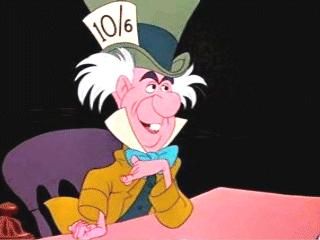

The mad hatter of 1951 looks far more tame than Johnny Depp's character. Coupled with his chirpy voice, Depp's character seems truly mad, potentially too crazy for a kid. Is this a pattern of new media taking old media (in this case books) and centering it for either the same audience, expecting that the kids of this day will enjoy the suspense and tricks in Burton's film or a pattern of centering it around a different age group? What would Jenkins' say about a parent's responsibility to talk to their child about movies like these. How does he suggest these conversations take place? Are they necessary? Does our society prepare kids to enjoy, understand, and accept movies such as these, at a younger age? Children are constantly being exposed to adult content on the television, on the radio, everywhere really. Still, there are movies made, such as Cars and Finding Nemo, for the age group Alice and Wonderland seemed to be targetting in Carroll's time and in the 1950s. Was the trippy Alice and Wonderland story inevitably meant to shift from a younger audience to an older one or has the new media, complete with modern animation, costuming, makeup, and acting, forced the story to change and become targeted to an older audience or an audience of the same age who are expected to understand the film? Who am I to say I wouldn't take a young child to the movie? I'm not a mother, and I expect as a mother I'd try to let my children do what they want. After all, Alice in Wonderland was my favorite book as a child. Maybe I would want my children to see the movie, as it's a wonderful story?
Another example of an old (ish book) turned movie is Roald Dahl's Fantastic Mr. Fox. Having read the book when I was younger, I saw the movie when it came out this year. The movie was phenomenal, with catchy music. In my mind it was an accurate representation of Dahl's book. The Fantastic Mr. Fox was written in 1970, not particularly long ago, but before the new media we see today.

The above two images are of the two book covers available, and below those is the trailer for the movie. The voices are of modern actors, but the animation holds true to the book's images and the story lines up well. This story could definitely have been made more violent or graphic in movie form, yet it wasn't. Both authors, Carroll and Dahl were deceased before the making of the films so they had no impact on the conversion of their books to the big screen. Was it left to producers? To directors? Who chose to change Alice and Wonderland or to emphasize it's freakiest aspects with intense graphics? Interestingly, the Fantastic Mr. Fox was rated PG for "action, smoking and slang humor." Is it fair to say that smoking is more friendly than trippy bunny rabbits and mad hatters? Or is there something to be said for the adultness of talking foxes, as a child would need to understand that they don't exist in real life. Whose to say that Alice in Wonderland has strayed more from being kid-friendly? According to the same site, film jabber, Alice and Wonderland was rated PG for "fantasy action/violence involving scary images and situations, and for a smoking caterpillar." What's worse? Is saying one's worse for kids than the other far too simple an observation or opinion? If Alice and Wonderland sparks the imaginations of hundreds of kids who go on to write fantastic novels, create new artistic techniques, and change the world with creativity, are Alice and Wonderland's advanced images of smoking caterpillars and fantasy action necessary or better than a movie that might not spark as much creativity such as the Fantastic Mr. Fox? Are we even able to compare the two movies? Maybe their audience is up to the discretion of parents, who can decide which movie is right for their kids and family. A child under eleven probably wouldn't be at the movies alone anyway, so the PG rating is relatively extraneous, although it does allow parent's to choose whether or not they think they should bring their kid to the movie or not.
Now that I've watched the Alice and Wonderland trailer multiple times perusing it for hints about its audience, I'm quite interested in seeing it. I forget how much I like Johnny Depp, and I'll always remember the Alice and Wonderland copy that resides as my favorite book from childhood on my bookshelf at home. Maybe some of my questions will be resolved in 3D tomorrow!

No comments:
Post a Comment