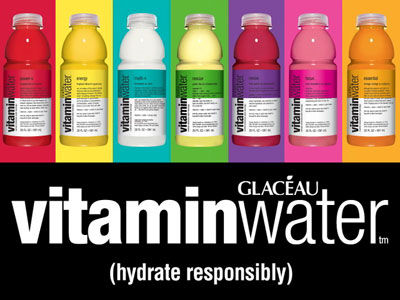
In the past few years water infused with vitamins and fruit flavors has become all the rage. In fact, a lot of my friends rely on these waters as a source of nutrients in their busy days or they rely on the comfort drinking vitamins brings them. If you read the label of a water fortified with vitamins it rarely has more than vitamin C and often contains tons of sugar or a sugar substitute such as sucralose. Your body needs no more than 100 percent of a daily dosage of vitamin C, so drinking a water with over 100 percent vitamin C is silly and unproductive. The companies have marketed these products very well and I have easily fallen prey to their charms and bright colors. I love Vitamin Water, produced by the Glaceau water company, recently bought by Coca Cola. I've tried every single flavor, ranging from blueberry-pomegranate to jackfruit-guava. I did not even know what a jackfruit was until drinking the jackfruit flavored Vitamin Water and googling the fruit. Apparently they grow in India and are popular in Brazil (http://www.crfg.org/pubs/ff/jackfruit.html). Vitamin Water mixes exotic fruits in exotic combinations that make the water seem ultra-special. The Vitamin Water website appeals to those of us who want to make our lives less complicated and relaxed. As the page loads, text reads "We'll spare you the cheesy on hold" music. Until taking Media Studies I visited the Vitamin Water Site and felt happy that they were saving me from seconds of some awful music. I completely bought into their "we're helping you out vibe," and by the time the page loaded I was ready to see the new flavors. Now I'm wary of the company as I find myself analyzing the ads I'm attracted to and the way advertisers hook people like me in. In fact, I like listening to music, and the loading process of vitaminwater.com is quite long and boring without music to listen to. Lucky for the advertisers, Vitamin Water has a wonderful flavor, and they're marketing truly tasty stuff. While the flavors are great, the advertising is what makes me go back every time for a newly released flavor, as their ads are very bright and in you face. I rarely miss them.
Another interesting marketing tactic they employ is the nouns they assign their waters, intangible things the water is supposed to bring a drinker. The raspberry-apple flavor is "defense," and there's a peach-mango one titled "endurance." It's ridiculous to believe that a water can assist in building up endurance, especially one fortified with vitamin e and ribose. Ribose is a sugar, and the bottle boasts sustained energy, when in fact drinking liquid sugar before a workout can lead to energy crashes. It's a big stinky fib, not quite a lie, yet certainly not a truth. Another hilarious little thing I noticed as I perused the website was the nouns associated with two flavors they have, one is b-relaxed, and the other is tranquilo. Tranquilo in spanish means calm, so by using essentially the same word in another language they have rendered their water exotic and themselves, in my mind, uncreative. They then dye the water bright colors, and it is truly special. Vitamin water ads also permeate the internet, at least many of the sites I access. It probably wasn't hard to track a vitamin water addict like me down via cookies, but I still find myself seeing disproportionate numbers of of vitamin water ads. It might be that I notice these ads more often, as they always use bright colors and blocky, flashy fonts.
The Vitamin Water craze seems to fit into a larger vogue water and vogue health food trend. Vitamin Water advertisements amalgamate the glamour of an alcohol commercial with the health benefits of an organic food item. The bright colors and flashy signs evoke vodka ads, pushing Cosmopolitans and other fancy drinks. These ads appeal to young twenty somethings striving to lead glamorous lives, filled with exotic drinks. The fancy flavors fit both in the alcohol category of making the audience feel as if all the flavors in the world are available to them, while the blurbs about health and wellness adorning every Vitamin Water bottle are very similar to those on health foods. The Odwalla Company has very similar blurbs about the power of the ingredients used to promote good health and wellness. Health foods are becoming more and more glamourous. Vitamin Water appeals to the young crowd who occupy cities and strive to live a life of exoticism and glitter, and the young crowd who wants to live close to the earth, and drink fruit infused waters. My mom is a cosmetic surgeon, and works often with city-dwelling wealthy women who live extremely privileged and glamorous lives. She always has a vitamin water display in a rainbow of colors, similar to the one above, so her customs can drink the water of young people while having procedures done to make them look younger. Underlying all Vitamin Water ads seems to be that laid back, I'm caring for myself without having to eat a salad, kind of vibe. They appeal to the side of us all that just wants to be chill and cool and nonchalant.
Companies like Vitamin Water, which market a very specific thing, interest me greatly. I wonder how they choose the demographic they will advertise to. Do they study advertising and market trends of past products that are similar? Do they practice trial and error, rolling ads until one of them sparks an increase in sales? I can try to pinpoint the type of people who would be interested in Vitamin Water by looking at the ads and interacting with people who consume it, but how did Vitamin Water know who exactly would be interested and how to get their attention? The company appears to be growing, as they release new flavored waters often. Coca Cola bought Glaceau in 2007 for 4.2 billion dollars (http://www.nytimes.com/2007/05/26/business/26drink-web.html), which alludes to some success in the company. Under such a powerhouse as Coca Cola, Glaceau and Vitamin Water seemed to have grown. As they've grown I've noticed that their flavors have gotten fancier and fancier. At the beginning they had lemonade, fruit punch, and grape, and now they have fruits I've never heard of, and I'm a major fruit lover. The company seems to be moving rapidly in the direction of the exotic and the cosmopolitan, and I wonder what has sparked them to do that. What types of people have responded to their ads, besides for girls named Anneke who go to prep school in Massachusetts?

No comments:
Post a Comment